|
|
|
|
| By Heather Rudow, Advocate Staff Writer | |
| March 16, 2010 | |
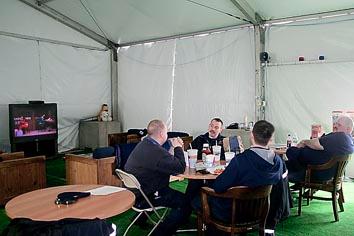
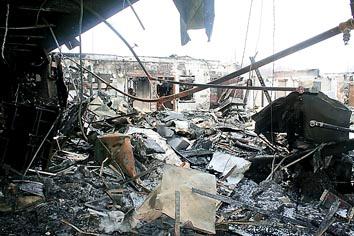
| The Advocate of Eldersburg and Sykesville has been reporting updates on the Sykesville-Freedom District Fire Department's progress on building a new firehouse after a roof collapse on Feb. 11 which led to a gas line in the kitchen to break and explode, which started a fire that destroyed the firehouse's banquet hall, living quarters and administrative offices. Between the fire itself and water damage from extinguishing it, the entire building has been rendered useless except for the portion housing their equipment. Members are currently spending their time inside trailers and tents. In an effort to update readers on what the living conditions are really like, one reporter decided to spend the night there. The first thing the members of the Sykesville-Freedom District Fire Department want to talk about upon my arrival isn't the fact that they're currently spending time inside a giant tent next to their partially burned down firehouse, but of my choice in footwear. "You are quite dressed up for spending the night at a firehouse," says Public Information Officer Dennis Beard, eying my black flats. Dave Cunningham, the fire department's senior paid paramedic, holds in a laugh. "It'd probably be best if you changed your shoes," he agrees. Blushing furiously and babbling incoherently about "professional attire," I quickly change into the tennis shoes I brought along in my backpack. I haven't even been here 10 minutes and they're already busting my chops, I think. It's going to be a long night. After a roof collapse, gas leak and fire on Feb. 11 that has rendered every portion of the Sykesville-Freedom District Fire Department's firehouse inhabitable except for its engine bay, members have been forced to live in trailers and tents until a new firehouse is constructed. This new living situation, erected two days after the fire, has changed the way members go about their daily routine at the firehouse. I figured that the best way to fully understand the ramifications of these conditions was to experience them myself, and spend a night at what is now become the Sykesville-Freedom District Fire Department. For a giant tent, the main area of this makeshift firehouse is surprisingly warm and cozy. Some of the members are sitting on the heavy, wooden furniture donated by the Gamber & Community Fire Department that surrounds a big-screen television, which is playing the latest episode of NCIS: Los Angeles. The dramatic music and gunshots from the show almost block out the whirring of the generators that are giving this place electricity. Others huddle around another table, working together on a crossword in the newspaper. On the other side of the tent a couple people are doing some paperwork, and another buys a can of soda from the candy machines resting against the side of the tent. The table next to the candy machines holds plastic cups, utensils and baked goods, and curiously has four golf clubs resting on either side of it. An opening in the tent leads to a kitchen area, with a stainless-steel prep table, washing station, freezers, refrigerators and hot boxes, as well as a grill, and a space heater that's close to four feet high. A wooden picnic table and benches are in the middle of the room, displaying a plate of french-fries and a cake. I've spent time at firehouses before, and everything about the scene is completely normal. I almost forget where I am, until Cunningham asks me if I want to see where I'll to be sleeping. He leads me through some double doors on the other side of the tent and into a dark room. He tells me that members have taken to calling the new living arrangements "Tent City," and that this bunkroom is drastically different from what they're used to. "We had nice beds," he says, "and wooden dividers between them. It's cramped now, and before it was not a co-ed dorm." I can see what he means. Metal piping with navy blue draping as thin as bed sheets are separating the six cots set up on my side of the room. There's no more than a foot and a half of space between the beds and the draping. Another door leads me to an area with two trailers on either side; one housing the showers, and the other for the restrooms. Unlike the bunkrooms the bathrooms have remained segregated between men and women, but to my chagrin they are just as cramped. I bump into the stall door at least eight times while attempting to step down the pedal situated next to the toilet in order to flush it. The showers are tantamount to the ones you would find when trying to wash off at a local pool, and in all honesty aren't that bad. Cunningham tells me that the area smells a lot better now than it did earlier, when it was discovered that there was a sewage leak coming from the men's room. They spent a decent part of the evening cleaning it up. "Now that was a fun time," he says. After touring the facilities I sit down with the members in the main room, presumably waiting for a call. Besides a brush fire around 6 p.m. and a couple medical calls it's been a relatively slow night. However, none of them are at all bothered by the fact that they have to do their waiting in the tent instead in lieu of their old digs. "Aside from the size, smell and cold weather it's just about the same," member Nik Carbini tells me. "We still laugh and joke all the time. It's the same atmosphere." What was already a tight-knit group of people has only grown closer since the fire. Their ability to make the best out of a bad situation is what continues to keep their spirits high. For example, the floor of the tent is covered in a bright-green plastic that looks a lot like Astroturf, and Carbini tells me they've used it as inspiration for modified version of golf (hence the golf clubs. "It's just something to pass the time," she says. "That and cards are the big things right now." Even though they are still able to enjoy their time here, they've had to make some adjustments in order keep everyone happy, such as the creation of Quiet Time. Starting at 9 p.m., members have to start being quiet. "The walls are so thin that you had people waking up at one or two in the morning because people were out there playing videogames," Carbini says. "They basically created Quiet Time so people wouldn't kill each other." Once again, I am reminded that I'm inside of a tent and not an actual building. Sykesville-Freedom District Fire Department's Vice President, David Kreimer, tells me that the thin walls are especially noticeable on windy days. "It's so loud out there that you'd think there was a gun out there shooting things," he says. Jennifer Wilhive agrees that their previous living arrangements were nowhere near as loud. "It's a lot noisier in here than it normally would be," she says. "Especially with all the generators running." All things considered, the next few hours are quiet. No calls come in, and we spend our time talking and watching T.V. I settle into my bunking area around 11:15p.m. I think of the hum of the generators as a white noise machine that is occasionally interrupted by chatter on the scanner. Relaxed, I begin to drift off to sleep. An hour later I am jolted out of my semi-conscious state by a series of beeps. A male voice from the scanner fills the room, speaking in a vernacular I am unfamiliar with. I do pick out a familiar word, "fire," throughout the jargon. I get on my shoes and follow everyone to our transportation. We have to go outside and past another trailer in order to get to the garage. Carbine hops into a medic unit, but is then informed that the call will only require a fire engine. She gets out and asks where Harry Elliot, the driver, is. He's still in the bunkroom. She now needs to go back outside, through the tent and into the bunkroom to grab him before we can leave. Later in the evening, Carbine explains to me that in the old building there was never this much confusion. When they got a call, all of the lights in the bunkroom would turn on, and a lighting system would either flash red for fire or blue for medical to indicate what types of people and equipment would be necessary. About two minutes later Elliot arrives and he, myself, and members Chris Urban, Holly Lugwig and Ed Rook Jr. quickly pile into the engine and speed off. The truck bumps and lurches just like a school bus, except it's moving at least 20 mph faster. Despite the jerkiness and the fact that it's pitch-black inside Urban and Lugwig-who's 17 and quite petite-somehow manage to get changed into their gear. Elliot turns on the flashing lights (no siren, to my dismay), and Urban and Lugwig make small talk about the calls they've run so far in 2010. We arrive at an apartment complex, where someone allegedly detected smoke. While Urban, Lugwig and Rook check out the scene I ask Elliot how different it is now when they get a call compared to before the fire. As I expect, he tells me the process was a lot more fluid and less confusing. "There used to be stairs leading directly upstairs and directly from the bunk," he says. "It was much easier." Urban, Lugwig and Rook return to the engine finding no sign of smoke or fire, and we return to the firehouse. It's about 1 a.m., and I quickly fall asleep. I am again ripped out of my R.E.M cycle at 2:36 a.m. from the beeps on the scanner. This time Carbine can hear that it's a medical call, so she and Cunningham make their way to the ambulance, with me, half-asleep, in tow. We meet police at Freedom Elementary School where they found a woman slumped over the wheel of her car in the school's parking lot. After Carbine and Cunningham check her vitals and ask her what happened, we take her to Carroll County Memorial Hospital to get checked out further. We arrive back at the firehouse around 4 a.m. "Home sweet home," Carbine jokes. Cunningham snorts. "I'm going to miss the tents when they're gone!" she says. "Come on!" which I can only assume she exclaims after receiving an incredulous look from Cunningham. "These are memories we're never going to get back!" she says. "I must have taken at least a hundred pictures by now." There are no calls the rest of the night. I wake up at 7:30 a.m. and head to work. As I'm turning onto Liberty Road I hear the familiar wail of sirens, and I watch the Sykesville-Freedom District Fire Department's bright yellow ambulance speed past me. I realize that it's going to take a lot more than a damaged firehouse to truly damage this firehouse. |
|