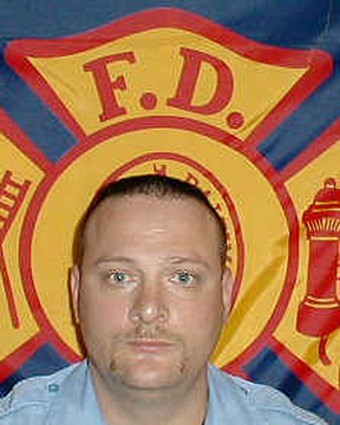
The men and women of the Sykesville-Freedom District Fire Department extend our deepest sympathies to the family and friends of our fallen brother in the Baltimore City Fire Department. Below is an article from the Baltimore Sun on the death of Firefighter Allen Roberts.
It was the type of call that any seasoned Baltimore firefighter has been on a hundred times - an early morning rowhouse fire with people reportedly trapped inside.
The fire engines pulled up to the two-story brick home on South Macon Street 2 1/2 minutes after dispatchers received a half-dozen 911 calls. Three firefighters - one veteran and two rookies - lugged a hose through the front door and began searching though suffocating heat and smoke.
It didn't feel right.
"You've got to get this place open. It's hot in here," one firefighter barked into his radio after spending six or seven minutes inside. The on-scene chief ordered them to leave the house.
But the heat had reached at least 1,800 degrees, and the first floor burst into flames. The ceiling partially collapsed and the door jammed shut, trapping the firefighters inside.
The two rookies - each with less than a year of experience - were rescued and suffered serious burns. The third, Allan M. Roberts, with 19 years on the job, was rushed to a nearby hospital, where he died of burns. The 40-year-old lived in Belcamp, Harford County, and had four children ages 1 1/2 to 13.
"We lost one of Baltimore's finest in the middle of the night last night," said Mayor Martin O'Malley. "A young firefighter who died in what might have been a typical rowhome fire. But it was anything but typical."
The man and woman reported to be in the home had escaped by the time the first firefighters arrived at 514 S. Macon St. in Southeast Baltimore's Greektown neighborhood. The woman walked out of the house, and the man jumped from a second-floor window into the arms of his neighbors below. The man, whose name was not released, was being treated at a hospital last night.
The firefighters weren't as fortunate.
"When things went bad, we didn't get all of our people out in time," Baltimore Fire Chief William J. Goodwin Jr. said at a news conference in front of the blackened home last night. "We've gone over and over and over it in our minds. What if? What if? That's what we've been battling with."
Roberts is the first city firefighter to die battling a blaze in more than a decade. Eric D. Schaefer was killed in September 1995 in the eight-alarm Clipper Industrial Park blaze when a granite wall fell at the 19th-century iron foundry in Woodberry, which was being used as artist studios.
Yesterday's fire, reported after 2 a.m., spread to the two adjacent rowhouses and was extinguished in about two hours. City and federal investigators said yesterday that they were trying to determine the cause. They do not think it was intentionally set.
The fire was unusually intense, Goodwin said. Old paneling and dry wooden materials inside acted as kindling, fueling the fire. The home was built in 1920.
As the firefighters in the house were retreating, Goodwin said, there was a "flashover," a firefighter's term for a situation in which the heat generated by a fire is so great that it causes everything near it to give off flammable gases and burst into flames.
"The interior heat builds and builds, and the interior reaches a flash point," Goodwin said.
Theodore G. Saunders, the city's fire marshal, likened a "flash- over" to what happens to a piece of paper near a campfire. If the fire creates enough heat, he said, the paper will burn when it gets near the fire. The same phenomenon occurs with furniture, paneling and carpeting, Saunders said.
Goodwin said flashovers are common, particularly in older homes.
"As sophisticated as our department has become, sometimes things go wrong," Goodwin said. "Things like that happen."
Fire inspectors are reviewing radio transmissions from the scene. They know that there was a call for a retreat but are not sure what caused the flashover. It could have been the partial collapse of the ceiling, or the collapse might have helped spark the flashover.
The force of the flashover blew the front door shut, and the hose became jammed in the door, Goodwin said. Firefighters outside the home struggled to push the door open, while the men inside tripped over each other as they tried to escape the heat.
"It is not a ballet when we fight fires." Goodwin said.
Firefighters outside the house finally punched a hole in the door and rescued Brandon Mattox and James Butler, and carried out Roberts. About 20 minutes later, part of the roof collapsed.
Mattox and Butler suffered second-degree burns on their arms and were rushed to Johns Hopkins Bayview Medical Center.
"They both had life-altering burns," Goodwin said. Mattox was in the burn ward yesterday, and Butler had been released.
City fire inspectors and federal agents with the Bureau of Alcohol, Tobacco, Firearms and Explosives, who join in investigations of fatal fires in the city, spent yesterday sifting through debris and stabilizing the home. They blocked off the entrance with yellow tape and were to return today to search for more clues.
Saunders, the fire marshal, said some of the metal inside the house became so hot that it melted.
Firefighters do not often die while fighting fires; about 100 perish every year across the country, roughly 75 percent from heart attacks or vehicular accidents, according to federal fire statistics. Those numbers are down significantly from before the early 1970s, when three times as many firefighters died each year. Improved fire equipment and safety standards is credited with the reductions.
Martin Dashields, a 10-year veteran of the Baltimore department, sat on the bumper of a fire engine yesterday. "A lot of times we become complacent," he said, "Everything is OK until something happens. ... How do you have so much damage in such a short period of time?"
Roberts' wife, Teresa, said she always knew that "something" could happen. She said he had previously come home with cuts and bruises.
"You know that's part of the job," she said. "But you also can't ask somebody to stop doing what they enjoy doing. I knew that going in."
Her husband loved his job. In 1994, Roberts rushed into a burning apartment and saved an infant from a crib, a night his first wife recalls clearly.
"I remember the night that he came home and he just wanted to hold our daughter," said Alice Marie Ritter. Roberts was recognized by the department with an Exemplary Performance Award.
When he wasn't fighting fires, he tried to spend as much time as possible with his four children. He had two daughters from his marriage to Ritter and two sons with his current wife.
At the firehouse where Truck 26 is based, on Mannasota Avenue in Northeast Baltimore, Roberts told stories about his children, and photos of his daughters were taped to his locker. The girls sometimes played on the firetrucks, and he took children for rides on his motorcycle.
"His 5-year-old [son] was his best friend," said Capt. David Goldman who worked on Roberts' shift and knew him for 17 years.
Goldman said he had a close relationship with Roberts. "He could call me up, and I would listen. If I could help him out, I would," he said.
Roberts' life was not free of problems. Many of his colleagues referred to difficulties he was trying to overcome, and one said Roberts had recently turned to God.
"He was having normal struggles that anybody you know might have," said Anthony Carter, a firefighter who worked with Roberts. "I think he was turning a corner. I could see it in his eyes. ... It was almost an eerie peace that was in his eyes."
The men on his shift gathered at Roberts' firehouse yesterday - their day off - after they heard the news. Other firefighters draped the front of the firehouse with black bunting, and the mayor and governor ordered flags flown at half-staff in the city and state. Roberts' dress cap was on top of his locker. Funeral plans were not complete yesterday.
"We came together and we'll probably cry together," Goldman said. "It is hard to lose someone in the fire department, but when you lose someone who you work with it is a whole different animal." |

 Add a Comment